


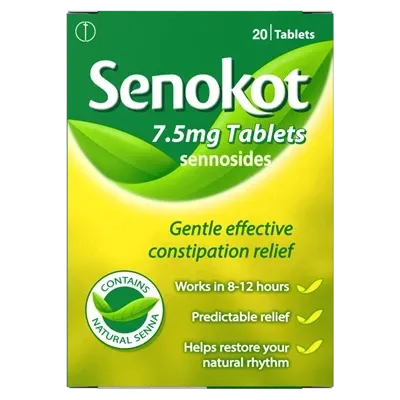
Senokot 7.5mg Tablets
- Gentle effective constipation relief
- Works in 8–12 hours
- Helps restore your natural rhythm
- Predictable relief
Product Details


You can ease your symptoms at home by changing your diet and lifestyle.
The following changes can make your stool softer and make it easier for you to empty your bowel:
Try to move around more. You can increase your activity level by doing a little extra in your day, whether it’s light stretching, or getting some air.
If changing your diet and lifestyle doesn’t seem to help, you might need to try a laxative to help ease symptoms. Available over the counter from pharmacies and supermarkets and prescriptions from your GP.
It is recommended* to use a bulk forming laxative as a first approach, such as ispaghula husk (Fybogel) and methylcellulose. These laxatives increase the weight of stool lying in the bowel, which makes you feel you want to go to the toilet. When taking bulk forming laxatives, drink lots of water to keep you hydrated. Bulk forming laxatives take 2-3 days to work.
If a bulk forming laxative does not relieve your constipation, try an osmotic laxative such as Macrogol. Osmotic laxatives work by drawing water into the bowel. This makes the stool softer, so you’ll find it easier to empty your bowel. They get to work in about 2-3 days.
If you’re still having problems, stepping up to a stimulant laxative can help, such as senna (Senokot), bisacodyl, and sodium picosulfate. They work by stimulating the muscles of the lower gut, making them work harder to move the poo along with the bowel. Working quicker than bulk or osmotic laxatives, taking about 6-12 hours.
These work by drawing water into the stool, making it softer. These include Arachis oil and docusate. You may find stool-softener laxatives useful if you find it hard to increase your fluid intake.
Laxatives are for occasional use if lifestyle and diet measures do not help. You should stop taking them once your bowels become regular again. If you’re still having problems after a week, speak to your GP. Don’t self-treat with laxatives if you have ulcerative colitis or Crohn’s disease.
Some laxatives are more appropriate than others during pregnancy, for example Fybogel Orange (Ispaghula Husk Granules) may be used during pregnancy if necessary and if change of nutrition is not successful. However, you should always consult a doctor or pharmacist before taking fybogel or any medicines during pregnancy. Also always check the pack or product information leaflet. Speak to your GP if diet and lifestyle changes do not help. Laxatives aren’t usually recommended for children unless advised by a doctor. Medicines can affect the unborn baby. Always talk to your doctor or pharmacist before taking any medicine in pregnancy.
Speak to your GP if you have any concerns or if:
*Treatment guidelines from NICE (national institute for health and care excellence for England and Wales)

Product Details
Product Details
Product Details